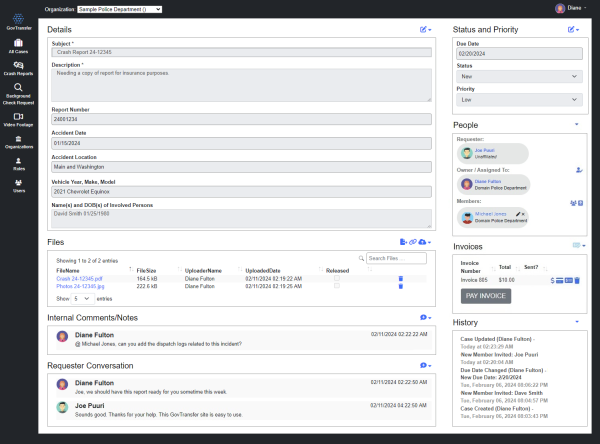
Effective inter-agency data transfer lies at the heart of modern public-sector collaboration. When information moves quickly, securely, and accurately between departments, decision-makers gain the real-time insight needed to respond to crises, streamline services, and allocate resources efficiently. Yet many governmental bodies still grapple with fragmented systems, inconsistent standards, and legacy infrastructure that impede seamless exchange. By aligning technology, policy, and process, agencies can transform data silos into a unified ecosystem that supports both routine operations and emergency response. The following guide outlines proven practices for optimizing inter-agency data transfer, offering actionable steps that can be implemented across a variety of governmental contexts.
Establishing a Unified Data Governance Framework
A robust governance model creates the foundation for trustworthy data sharing. It defines who can access what, under which circumstances, and ensures compliance with legal and security mandates.
Key Components
- Clear Ownership: Assign data stewards for each dataset to manage quality, permissions, and lifecycle.
- Standardized Policies: Adopt uniform classification, retention, and privacy policies that align with federal regulations.
- Audit Trails: Implement automated logging to track access and modifications, supporting accountability and forensic analysis.
For a deeper dive into governance best practices, Discover expert strategies here.
Implementing Interoperable Technical Standards
Technical incompatibility is a common barrier to smooth data exchange. Selecting open, widely-adopted standards reduces the need for custom adapters and minimizes translation errors.
Data Formats and Protocols
- Use JSON or XML for structured data exchange, ensuring schema consistency across agencies.
- Adopt RESTful APIs with OAuth 2.0 for secure, token-based authentication.
- Leverage HL7 FHIR for health-related data, enabling rapid integration with clinical systems.
Metadata Management
- Employ a common metadata registry to describe data lineage, quality metrics, and usage constraints.
- Utilize semantic vocabularies (e.g., DCAT, ISO 19115) to promote discoverability.
To explore technical guidance tailored to government environments, Learn about our tailored solutions.
Securing Data in Transit and at Rest
Security cannot be an afterthought. Agencies must protect sensitive information from interception, tampering, and unauthorized access throughout its lifecycle.
Encryption Practices
- Apply TLS 1.3 for all API communications.
- Encrypt data at rest using AES-256, with key management handled by a centralized hardware security module (HSM).
- Rotate encryption keys regularly and enforce strict access controls.
Identity and Access Management (IAM)
- Implement federated identity using SAML or OpenID Connect to enable single sign-on across agencies.
- Adopt role-based access control (RBAC) that aligns with the principle of least privilege.
- Conduct regular penetration testing and vulnerability assessments.
For additional security recommendations, Explore advanced guides and tips.
Optimizing Performance and Scalability
High-volume data transfers must remain responsive under peak loads, especially during emergencies or large-scale public initiatives.
Architecture Choices
- Utilize message queues (e.g., Apache Kafka) to decouple producers and consumers, enabling asynchronous processing.
- Deploy micro-services that can be scaled horizontally based on demand.
- Leverage cloud-based storage with automatic tiering to balance cost and speed.
Monitoring and Automation
- Implement real-time metrics dashboards to track latency, error rates, and throughput.
- Set up automated alerts for threshold breaches, triggering remediation scripts.
- Use infrastructure-as-code (IaC) tools to provision resources consistently across environments.
To see how scalable solutions are applied in practice, Find out more about this approach.
Facilitating Cultural and Organizational Alignment
Technology alone cannot guarantee success; agencies must cultivate a collaborative mindset and shared responsibility for data stewardship.
Training and Change Management
- Offer regular workshops on data standards, security protocols, and API usage.
- Create cross-agency working groups to address common challenges and share lessons learned.
- Recognize and reward teams that demonstrate exemplary data sharing practices.
Policy Integration
- Embed data-exchange objectives into agency strategic plans.
- Align budget allocations with the required technology upgrades and training initiatives.
- Establish joint performance metrics that reflect inter-agency collaboration outcomes.
For guidance on fostering a collaborative culture, Discover expert strategies here.
Measuring Success and Continuous Improvement
Ongoing evaluation ensures that data-transfer initiatives remain effective and adapt to evolving requirements.
- Key Performance Indicators (KPIs): Track data latency, error rates, user satisfaction, and compliance audit results.
- Feedback Loops: Gather input from end-users and adjust processes or technology configurations accordingly.
- Periodic Reviews: Conduct quarterly assessments to validate that governance, security, and performance standards are being met.
Continual refinement, supported by proven frameworks and expert insight, turns inter-agency data exchange from a challenge into a strategic advantage. By applying the practices outlined above, governmental bodies can achieve a seamless, secure, and scalable collaboration environment that serves citizens more effectively.